Disclosure: As an Amazon Associate we earn from qualifying purchases. Links go to Amazon search results so you can compare listings yourself. Prices below are planning categories only, current as of October 25, 2026 — always check the current price at checkout.
A tiny home living area is usually one room doing three jobs: sitting, dining, and sleeping. A sleeper sofa, futon, or murphy-style seat can give you a real place to sit and sleep without dedicating half your floor to a permanent bed. But convertible furniture has a failure mode regular sofas do not: comfortable to sit on, miserable to sleep on.
This guide does not rank one model above all others — the right choice depends on your floor plan, who sleeps on it, and how often it converts. For the wider picture, see our guide to furnishing a tiny home and our space-saving furniture guide.
What is the best sofa for a tiny home?
The best sofa for a tiny home fits your room twice: once folded, as a sofa, and once unfolded, as a bed. Sketch your living area, mark the doors, walkways, and anything that cannot move — a heater, a stair, a loft ladder — then check every candidate against both footprints. A sofa that fits against the wall can still fail if unfolding it blocks the bathroom path.
Be honest about who sleeps on it and how often. A guest bed used a few weekends a year can be simpler and firmer than a nightly bed. If it is your nightly bed, mattress quality matters far more than the mechanism, so budget for a good topper. If guests use it, ease of conversion matters most.
Are sleeper sofas the best option for tiny homes?
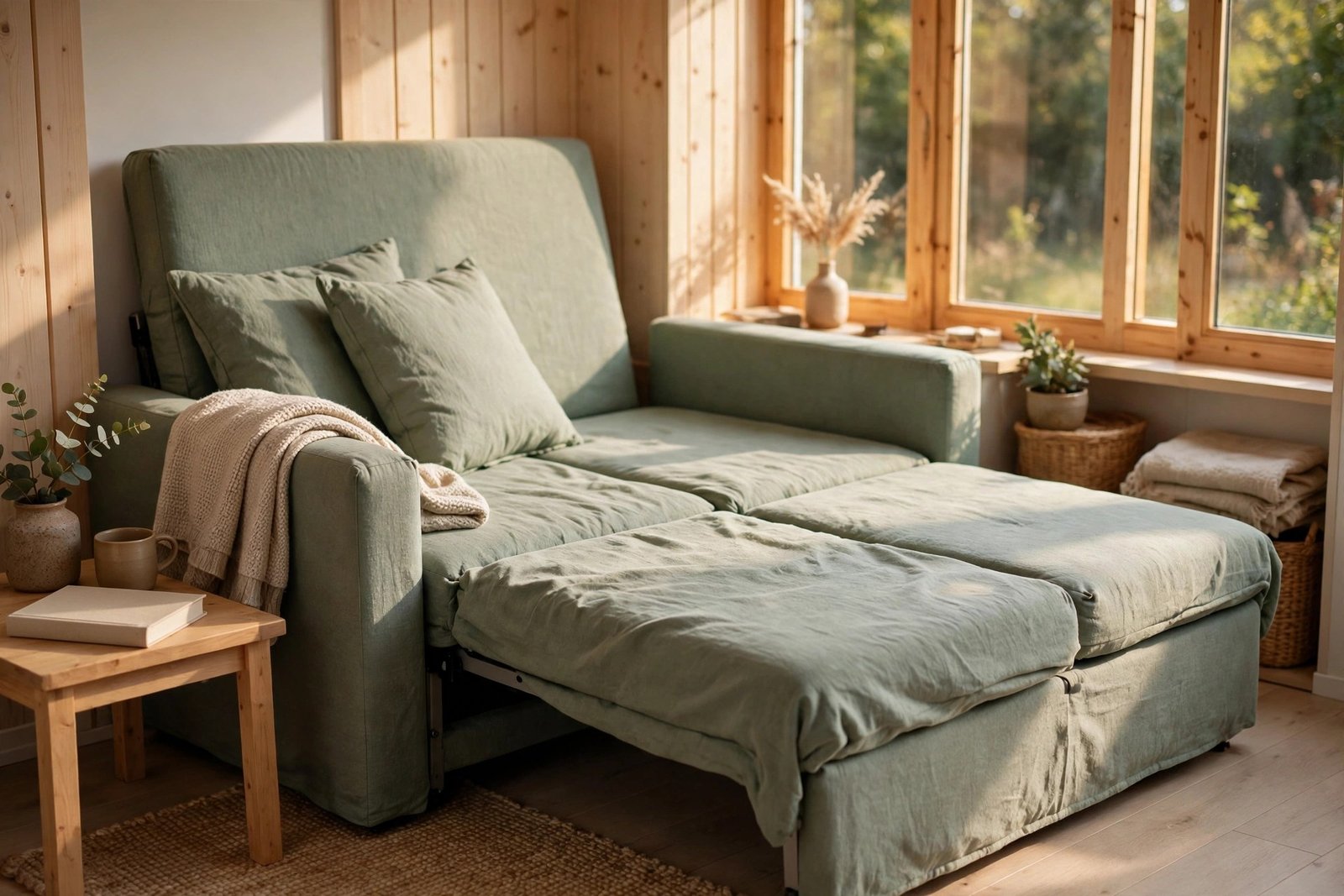
A sleeper sofa looks and sits like an ordinary sofa, then pulls out into a bed. That familiarity is its strength: it suits a living area that should feel like a living room first, and it usually offers the best seating comfort of the three types. The trade-off is mattress thickness — the folded mattress is thinner than a regular one, so nightly sleepers add a topper.
Check whether one person can operate the mechanism comfortably, and whether the bed needs clearance in front or pulls out from the side.
Shop compact sleeper sofas on Amazon →Are futons good for tiny homes?
Futons are the simplest and usually the lightest option. A futon frame converts from sofa to bed in seconds, with no hidden mechanism to jam, and the whole piece is easier to carry in and rearrange than a sleeper sofa — ideal for a studio layout, a guest corner, or a tight budget.
The compromise is comfort and looks. Futon mattresses are thinner and firmer than most sleeper-sofa mattresses, and the frame-and-cushion look is more casual than a fully upholstered sofa. For a nightly bed, plan on a quality mattress and a washable cover; for occasional guests, a standard futon mattress is usually enough.
Shop futons on Amazon →What is murphy-style seating, and when does it win?
Murphy-style seating folds up against the wall or into a cabinet when not in use, freeing the floor completely during the day. In the smallest homes, that is the decisive advantage: no other type gives you back the whole footprint. A murphy cabinet with a sofa front is the most flexible version — seating by day, bed by night. Our murphy bed guide covers the wall-bed side.
The catch is installation and wall space: these pieces need a solid, flat wall, secure anchoring, and the swing area kept clear. They cost more than a futon and often more than a sleeper sofa, and moving one later is a bigger job. They win when floor space is scarcest and a suitable wall is available; they lose when you rent, move often, or have no wall to anchor to.
Shop murphy-style sofa beds on Amazon →How do you measure for a sleeper sofa in a tiny home?
Measure three things before you order, and write them down. First, the delivery path: every door width, hallway turn, and stair the piece must travel through. Measure the narrowest point, not the widest — a sofa that fits through the front door can still fail at an interior doorway or a tight turn.
Second, the folded footprint: the width, depth, and height of the sofa as it will sit day to day, plus room to walk past it. Third, the unfolded footprint: the full length and width of the bed once open, including any clearance the mechanism needs. Tape both footprints on the floor with painter's tape and live with them for a day — walk the room, open the doors, and try the bathroom path with the bed "out." Also check what sits around the piece: a tall murphy cabinet needs wall height and a clear swing zone.
What should you expect to pay?
For planning only, current as of October 25, 2026, convertible seating generally falls into three bands. Budget pieces — mostly futons and simple convertible chairs — are the lowest-cost way in, and suit guest use or a first setup. Mid-range pieces — better sleeper sofas and loveseat sleepers — are where most tiny-home owners land: better mechanisms, better mattresses, and upholstery that suits a living room. Premium pieces — well-built sleepers and murphy-style cabinet beds — cost the most but give back the most floor space or the best nightly sleep.
Shop loveseat sleepers on Amazon →What upgrades make a convertible bed sleep better?
A mattress topper is the single best upgrade for a convertible bed used nightly: it smooths out bars, seams, and thin spots, and folds away more easily than a full mattress swap. A washable slipcover protects the upholstery, and a small storage ottoman beside the sofa solves the bedding problem — sheets, pillows, and the topper live inside it by day.
Shop sofa bed mattress toppers on Amazon → Shop storage ottomans on Amazon →What should you avoid when buying convertible seating?
Buying on folded size alone. The unfolded bed is the size that causes problems — check both footprints first.
Ignoring the delivery path. Measure the narrowest door and the tightest turn, not just the room itself.
Choosing nightly-bed comfort last. If you sleep on it nightly, mattress quality and a topper matter most.
Blocking circulation. If unfolding the bed cuts off the bathroom, kitchen, or exit, rethink the layout — not the bed size.
Planning the whole tiny home, not just the sofa?
The Tiny Home Buyer's Playbook walks through layout, budgeting, and buying decisions step by step — $39, with worksheets you can use before you order anything.
See the Tiny Home Buyer's Playbook →Get Tiny Home Tips Free
New guides, product picks, and travel deals in your inbox.