Disclosure: As an Amazon Associate we earn from qualifying purchases. Links go to Amazon search results, so you can compare listings yourself — always check the current price at checkout.
Insulation is the least exciting part of a tiny home build, and the one you will feel every winter night. In a small space, a cold wall is the wall next to your bed. The heater works harder, corners stay cold, and moisture finds the gaps.
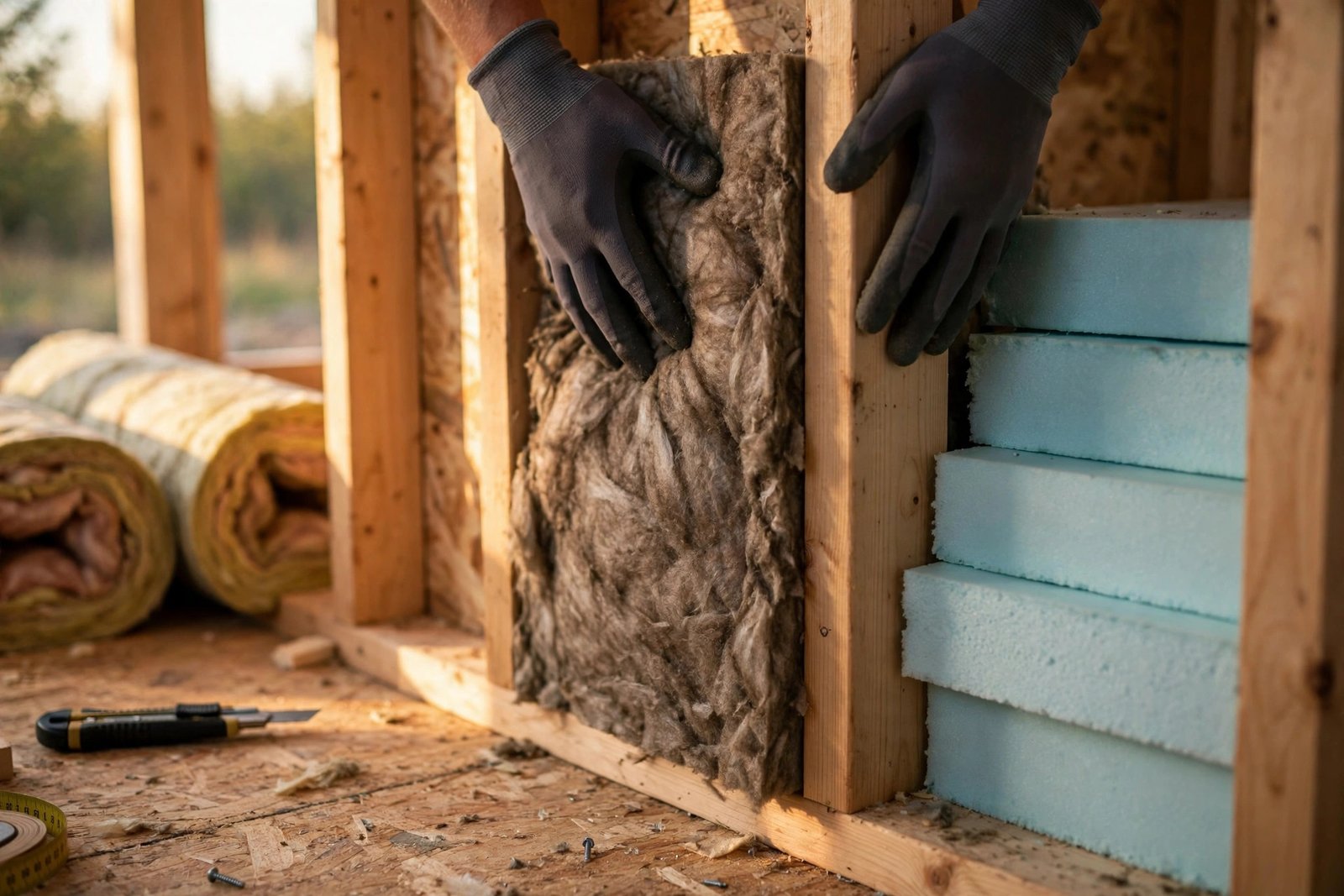
This guide compares the three materials most tiny home builders consider — foam board and spray foam, rockwool (mineral wool), and fiberglass — on cost, moisture, fire, thin-wall installation, and condensation. No material wins on all five. Our tiny home insulation guide covers wall build-ups, floors, and roofs.
Which insulation is best for a tiny home in winter?
There is no single best answer, because tiny home walls are usually thinner than a standard house wall — often a 2x4 cavity, about three and a half inches deep. A material that insulates well per inch matters more here than in a deep wall.
The short version: foam gives the most insulation per inch and the best air sealing, but costs the most. Rockwool is the balanced middle — good insulation, excellent fire resistance, good moisture handling — at a mid-range price. Fiberglass is cheapest, but easiest to install badly.
How does foam insulation compare for thin tiny home walls?
Foam comes as rigid board, cut and fitted between or over studs, and as spray foam, a liquid that expands to fill the cavity. Both insulate more per inch than batts — a real advantage in a three-and-a-half-inch wall. Spray foam also seals air leaks as it fills, closing gaps around wires and framing that batts miss.
The trade-offs are cost and care. Spray foam is the most expensive option and usually a job for a trained installer, because mix, thickness, and curing all matter. Rigid board is cheaper and more do-it-yourself friendly, but cutting it snugly around every stud and outlet takes patience, and every gap is a cold bridge. Most foam must also be covered by an approved thermal barrier, such as drywall. Always follow the manufacturer's instructions and local code, and never leave foam exposed in a living space unless the product is rated for that use.
Shop rigid foam board insulation on Amazon → Shop spray foam insulation kits on Amazon →Is rockwool worth the extra cost in a tiny home?
Rockwool, also sold as mineral wool, is spun rock fibre pressed into firm batts. It insulates well — better per inch than fiberglass, though not as well as foam — and has two strengths that matter in a small home. First, it is highly fire resistant and can slow fire spread, a comfort where kitchen, heater, and loft are steps apart. Second, it handles moisture far better than fiberglass: it absorbs little water and dries out if it gets wet.
Rockwool batts are denser and stiffer than fiberglass, so they hold their shape and rarely slump, making a snug fit easier. They are heavier to handle and need a sharp knife and gloves. Price sits in the middle: more than fiberglass, less than spray foam — the sweet spot for many year-round tiny homes.
Shop rockwool mineral wool batts on Amazon →Is fiberglass good enough for a tiny home?
Fiberglass is the cheapest insulation here, sold everywhere, and easy to install: cut the batt, press it between the studs, move on. In a mild climate, or a part-time cabin not heated through hard freezes, it can be adequate. The problem is how unforgiving it is of imperfect installation — and tiny home walls are full of imperfect spots: wiring, plumbing, outlets, corners.
Compressed fiberglass loses value, because its performance comes from trapped air, and squashing it squeezes that air out. Gaps let warm air bypass it entirely. It also suffers most from moisture: once wet, it sags and dries slowly. Use it only where you can fit it full and snug, keep it dry, and seal air leaks separately, per the manufacturer's instructions.
Shop fiberglass insulation batts on Amazon →What causes condensation in a tiny home wall?
Condensation is the quiet enemy of tiny home walls, worse in winter. Warm, moist indoor air — from cooking, showering, breathing — moves toward the cold outer wall and condenses into liquid water inside it, where you cannot see it. Over time, hidden damp feeds mould and rots framing. Small homes make this worse: the same moisture sits in far less air, and thin walls put the cold surface closer to the warm inside.
No insulation alone solves condensation. What helps is a complete wall system: gap-free insulation, air sealing, a vapour control layer placed correctly for your climate, and ventilation such as a bathroom fan venting outside. Steel-framed homes need extra care, because steel conducts cold through the wall and creates cold spots. If unsure about the vapour layer, check with your local building department before closing the walls. Our winter living guide covers heating and skirting, and our insulation materials guide covers floors and roofs.
Shop vapour barrier sheeting on Amazon → Shop insulation tape and air-sealing supplies on Amazon →How much does tiny home insulation cost to plan for?
Prices vary by region, thickness, and labour, so treat these as planning ranges dated October 25, 2026 — not quotes — and check the current price at checkout. For a typical small tiny home, fiberglass is lowest-cost, rockwool sits in the middle, rigid foam board costs more, and professionally installed spray foam is highest. Do-it-yourself batts cost mainly materials and time; spray foam adds installer charges.
| Material | Cost | Moisture | Fire | Thin-wall fit |
|---|---|---|---|---|
| Foam board / spray foam | Highest | Good; spray seals gaps | Needs approved covering | Best per inch |
| Rockwool (mineral wool) | Mid-range | Good; dries well | Excellent | Good; holds shape |
| Fiberglass | Lowest | Weakest when wet | Non-combustible fibres | Fair; gaps hurt most |
Which insulation should you choose for your build?
Choose foam if your walls are very thin, winters harsh, and budget allows — spray foam where air sealing matters most, rigid board as a do-it-yourself step up. Choose rockwool for the best balance of insulation, fire resistance, and moisture tolerance at a mid-range price. Choose fiberglass if budget is tight and climate mild, with careful fitting.
Whichever material you pick, install matters as much as product: fill the cavity fully without compressing batts, seal gaps, get the vapour layer right, and ventilate. Always follow the manufacturer's instructions and check local code before starting — this guide does not replace them.
Planning a winter-ready tiny home?
Insulation, heating, and skirting belong in the same budget.
Use the free calculator →Get Tiny Home Tips Free
New guides, product picks, and travel deals in your inbox.